
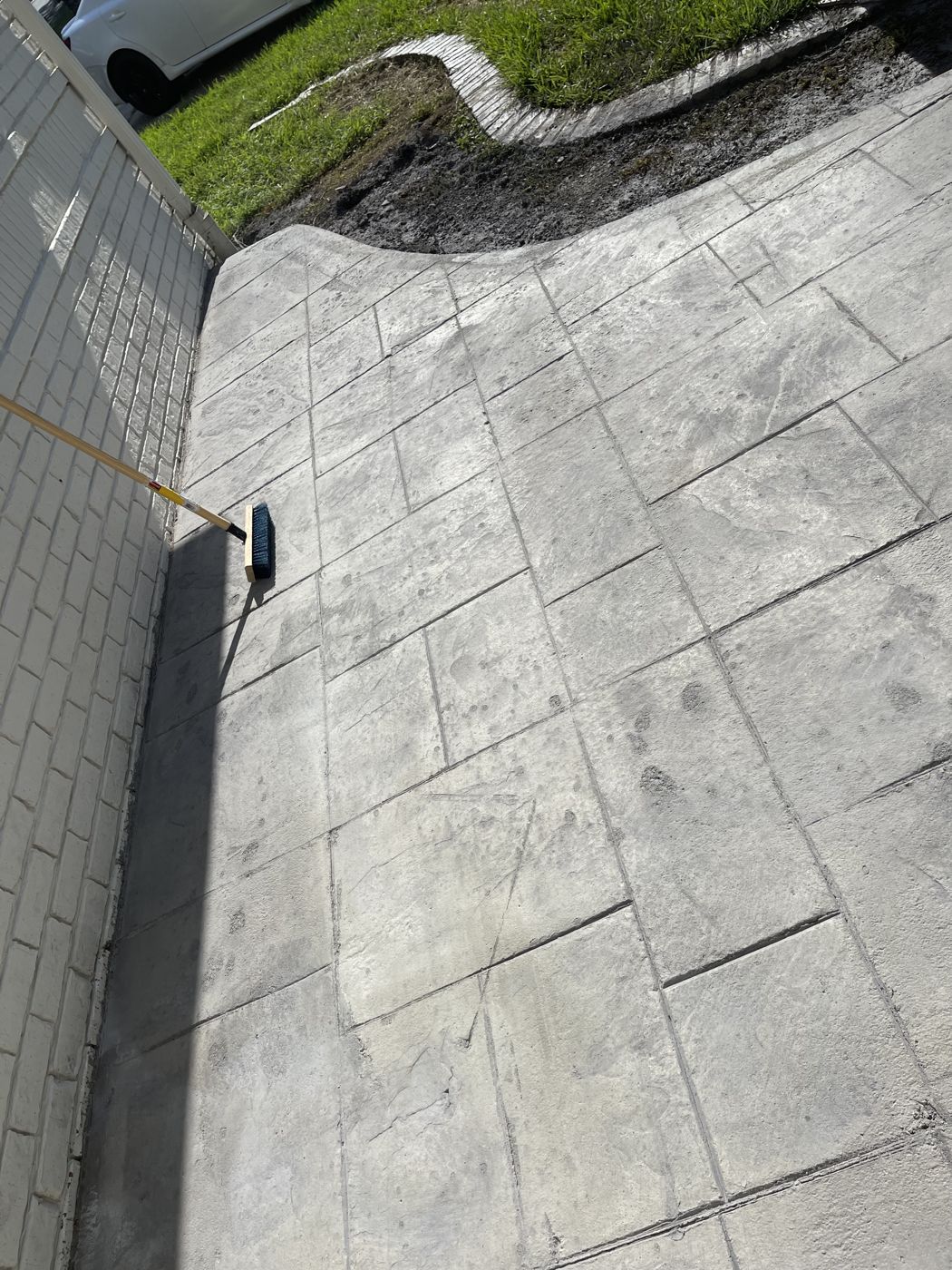
A concrete driveway in Mineola comes down to four things: how well the subgrade and base are prepared, slab thickness and reinforcement, where the control joints go, and where water ends up. Scope and price can only be fixed after someone walks the site and measures it.
What actually decides a driveway's lifespan?
Most driveways that fail early in East Texas do not fail because of the concrete. They fail because of what is under it. Our soils move with wet and dry cycles, and a slab poured over soft, uncompacted or poorly drained ground will crack and settle no matter how good the mix was.
So when we look at a driveway in Mineola, we are looking at four decisions in order: subgrade and base, thickness and reinforcement, jointing, and drainage. Everything else — finish, color, edging — comes after those are settled.
D&D Rustics has been doing residential construction out of Tyler since 2014, and our concrete services include site preparation and drainage planning as part of the job, not as an add-on. Every project is quoted on site after we see the ground, the access and the existing drive.
What does proper site prep look like?
Site prep starts with clearing: old concrete or gravel out, roots and organic material out, soft spots dug out and replaced. Organic material under a slab rots and leaves a void, and a void becomes a crack.
Then the subgrade gets shaped and compacted. The goal is uniform support across the whole footprint — not one end sitting on firm clay and the other on loose fill. On top of that goes a compacted base of crushed stone or similar material, which spreads load and gives water somewhere to go instead of pooling against the bottom of the slab.
This is the stage that is easiest to skip and hardest to see once the concrete is down. If you are comparing bids from any contractor, ask specifically what they are removing, what base material they are bringing in, how deep it goes and how it will be compacted. A bid that does not mention subgrade at all is a bid you cannot compare.
Thickness, reinforcement and joints — what to get in writing
Thickness is driven by what will park there. A drive that sees two cars a day is a different slab than one that has to carry an RV, a loaded trailer, a dually or a delivery truck turning around. Tell your contractor the heaviest thing that will ever sit on it, including occasional use, before the thickness gets decided.
Reinforcement — rebar or welded wire, and how it is supported so it sits in the slab rather than on the ground — holds cracked sections together and keeps them level with each other. Concrete will crack somewhere; reinforcement and jointing control where and how much it matters.
Control joints are the cuts you see in a finished drive. They give the slab a planned place to crack as it shrinks, instead of a random line across the middle. Joint spacing and depth should be part of the plan, not an afterthought on pour day.
Ask for all four in writing: slab thickness, reinforcement type, joint spacing, and base depth and material. Any contractor who is doing it right will have no problem putting those numbers on the estimate.
Where does the water go?
A driveway is a large impervious surface you are adding to a yard, and that water has to go somewhere other than against your foundation or into your garage. The slab should fall away from the house, and the ground alongside it should accept the runoff without turning into a trench.
On rural and semi-rural lots around Mineola and Wood County, the other end matters just as much: where the drive meets the road. If there is a roadside ditch, the approach usually involves a culvert sized and set so the ditch keeps flowing. A culvert that is crushed, undersized or buried backs water up and can undermine the end of your drive.
We plan drainage as part of the layout — slope direction, how the edges tie into the yard, and what happens at the road. If an existing culvert is failing, that gets addressed before new concrete goes over the top of it.
Repair or replace?
Not every tired driveway needs to come out. A single cracked section that is still level with its neighbors, a spalled patch near the garage, or a broken apron at the road can often be cut out and replaced as a section. You will see the seam, but the drive keeps working.
Replacement makes more sense when the problem is underneath: multiple panels that have settled at different heights, widespread cracking with vertical displacement, edges crumbling along most of the run, or a slab that was poured too thin for how it is being used now. In those cases, patching is money spent on a surface that is going to keep moving.
The honest way to decide is to look at it. Send photos, then let someone walk it. We will tell you if a section repair is the better buy.
Broom finish or a decorative finish?
Most Mineola driveways get a broom finish: a light texture that gives traction when it is wet and is simple to clean. It is the default for a reason.
We also do decorative and stamped finishes, which are more common on walkways, entries and patios where the drive is part of the view from the house. Stamped work costs more and asks for a bit more upkeep, so it is worth deciding where it earns its place. If you are weighing surfaces for an outdoor area, our comparison of a concrete patio versus a paver patio covers the same trade-offs in more detail.
A common approach is a broom-finished drive with a stamped or banded apron and walkway, so the detail lands where people actually see it.
Do you need a permit in Mineola?
Do not assume Mineola's rules match Tyler's. Requirements for driveways, culverts and work in the public right-of-way vary by city and county, and they can differ again if your property is outside city limits or your drive connects to a county or state-maintained road.
Before work starts, contact the City of Mineola if you are inside the city, and Wood County if you are not, and ask three things: whether a permit is required for the driveway itself, what approvals apply where the drive meets the road, and whether contractors must be registered with them. Confirm it with the city or county directly rather than relying on a contractor's word, including ours.
For an example of how detailed a city's rules can get, the City of Tyler Unified Development Code sets out driveway, sidewalk and contractor registration requirements — but those apply inside Tyler city limits only. We wrote up what they mean in practice in our guide to concrete driveway permits in Tyler. Treat it as an illustration of the kind of questions to ask Mineola, not as Mineola's rules.
What to have ready for an estimate
Four things make a site visit productive. Rough dimensions of the area, including length from the road. What the drive has to carry — daily parking, an RV, a trailer, farm equipment. Whether concrete trucks can get close, or whether access is tight, soft or uphill. And photos of the existing drive and the point where it meets the road.
Pricing depends on scope, materials, site conditions and access, and we confirm it after the project has been reviewed. We do not quote driveways over the phone, because the things that drive the cost are all things you have to stand on the lot to see.
Active-duty military members and first responders get a discount. Mention it when you call.
D&D Rustics works in Mineola and across East Texas from our base in Tyler. Call (903) 787-0477 or get in touch to set up a site review.
Frequently asked questions
How long before I can drive on a new concrete driveway?
Curing time depends on the mix used, the weather during and after the pour, and what you will be parking on it. Hot, dry or cold conditions all change the timeline. We give you a specific hold time for your pour before we leave the site, and that is the one to follow rather than a general rule of thumb.
Can you match the finish of my existing driveway?
We can usually get close on a broom finish and panel layout, but a new section will not be an invisible match. New concrete cures to a different shade than concrete that has been in the sun for years, and it will lighten over time without ever being identical. We will tell you honestly how noticeable the seam is likely to be before you decide between a section repair and a full replacement.
Do you work outside Tyler?
Yes. We are based in Tyler and work throughout East Texas, including Mineola, Lindale, Hawkins, Chandler, Brownsboro, Athens, Longview, Kilgore, Henderson, Frankston, Palestine and the surrounding towns.
Can you pour a driveway over the existing concrete?
Sometimes, but it is rarely the right answer. An overlay inherits whatever is wrong underneath, so if the old slab has settled or cracked from movement in the subgrade, the new surface will follow it. We would rather remove the old concrete, correct the base and start from solid ground. We will tell you after looking at it which approach actually fits your drive.
What time of year is best to pour a driveway in East Texas?
Concrete can be poured in most of our weather, but extremes make it harder to control. Very hot days speed up the set and heavy rain soon after a pour can damage the surface, so we watch the forecast and schedule around it. If timing is tight, tell us your deadline early so we can plan the pour window.