
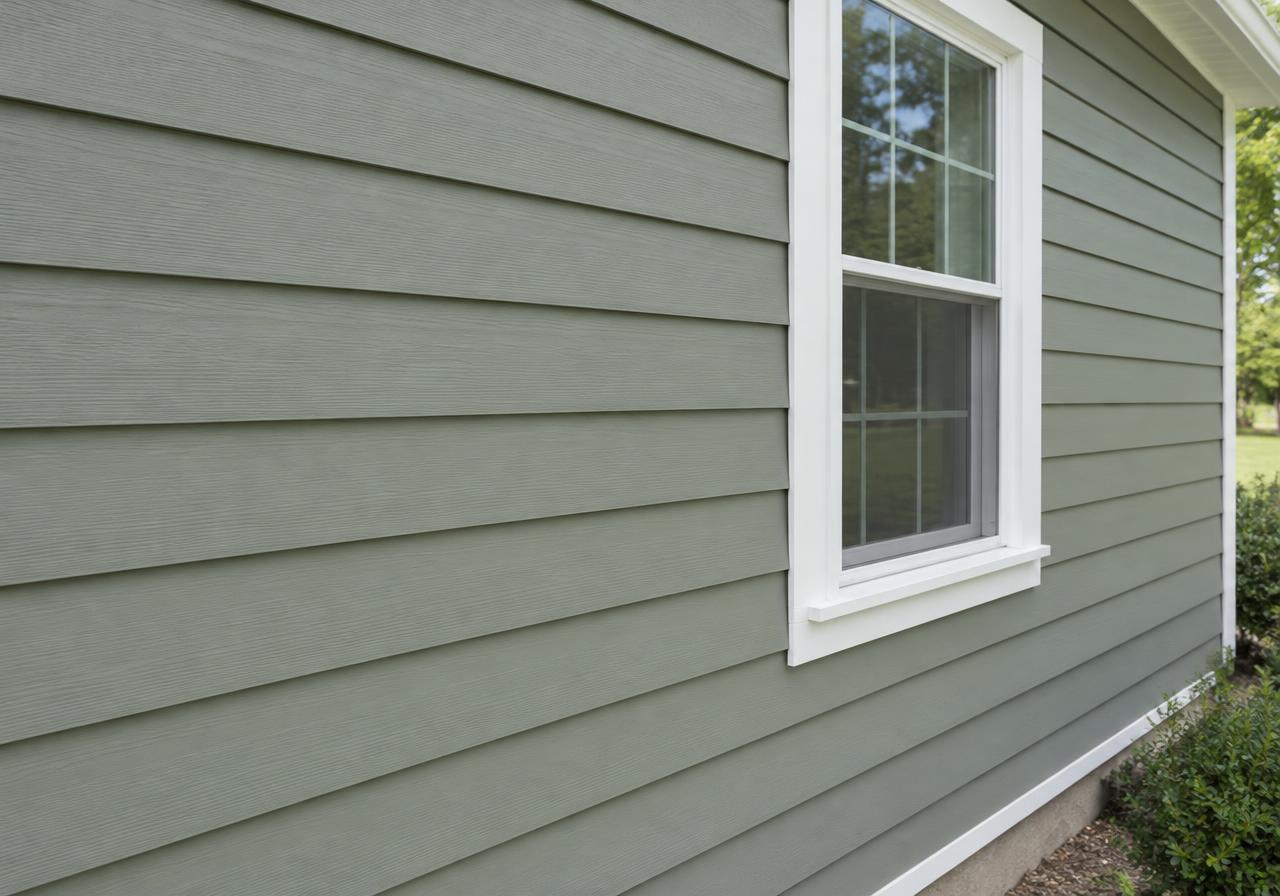
Vinyl tends to suit homeowners who want a lighter, lower-maintenance exterior that never needs painting. Fiber cement tends to suit homeowners who want a heavier, paintable board with a more traditional look. On most East Texas homes, though, the condition of the sheathing, flashing and trim behind the siding decides more than the material does.
What actually separates the two materials?
Vinyl siding is a formed PVC panel. It comes in long runs, hangs on nails that are deliberately left slightly loose so the panel can expand and contract with temperature, and it locks into the course below it. The color goes through the material, so it is not painted on site.
Fiber cement siding is a cement-based board reinforced with fiber. It is noticeably heavier and more rigid, it is cut rather than snapped, and it is fastened tight to the wall rather than hung loose. It is usually painted — either pre-finished from the factory or field-painted after installation — and it uses its own trim and corner details.
Those differences drive the rest of the decision. Vinyl is faster to install and easier on a wall that cannot take much weight. Fiber cement gives you a thicker shadow line and a finish you can repaint in a different color later. We confirm the specific product, trim and fastening details for your home before we price anything, because manufacturers each publish their own installation requirements and those requirements are what the warranty rides on.
How does maintenance and repair compare?
With vinyl, the normal upkeep is washing. There is no repainting cycle. Repairs are panel swaps — a damaged piece is unlocked from the course above and a new one is slid in. The catch is matching. Vinyl profiles and colors change over the years, and sun exposure shifts the color of what is already on the wall, so a patch on a fifteen-year-old run rarely disappears. If you have leftover panels in the garage from the original job, keep them.
With fiber cement, the upkeep is paint and caulk. Joints, trim intersections and cut ends are where water finds a way in, and those details need to be inspected and touched up rather than ignored. The upside is that a repaired board can be primed and painted to match the rest of the wall, and the whole exterior can be recoated in a new color without replacing anything.
Neither material is maintenance-free. One trades painting for color matching, the other trades color matching for painting.
What does the East Texas climate do to an exterior?
Around Tyler we get long, hot summers, high humidity most of the year, and storms that drive rain sideways into walls instead of straight down. Sun beats on south and west elevations year after year. That combination is hard on sealant joints, on paint, and on anything that lets water sit.
Here is the part homeowners do not hear often enough: siding is a rain screen, not a seal. Water is going to get behind it. What keeps a wall dry is the layer underneath — the housewrap or building paper, the flashing over windows and doors, the kickout flashing where a roof meets a wall, and the way trim and penetrations are detailed. If those are right, both materials perform. If they are wrong, neither material saves the wall, and you will be opening it back up in a few years.
That is why we look at the existing wall before we talk about product. If there is soft sheathing, rot at the bottom course, or staining under a window, the siding choice is the smaller conversation. Our water damage and water intrusion repairs and our siding work often end up on the same job for exactly that reason.
Should you repair the siding or replace all of it?
Spot repair usually makes sense when the damage is contained and explainable — a tree limb hit one elevation, a section cracked from impact, a few boards rotted below a leaking gutter — and the rest of the wall is sound and reasonably matchable.
Replacement usually makes more sense when damage shows up in several places at once, when the material is brittle or chalking across whole elevations, when you find rot in more than one spot after opening a small area, or when the original flashing and water management were never right. Chasing that with patches costs more over time than doing the wall once.
Either way, the honest answer comes from opening a small area and looking at the sheathing. We would rather pull a few boards and tell you the wall is fine than quote a full replacement you do not need.
Do you need a permit for siding work in Tyler?
Permit requirements depend on the scope of the work and on whether your property is inside Tyler city limits. The City of Tyler takes permits and plans electronically through its eTRAKiT and ProjectDox system, and publishes its residential permit checklist, contractor registration forms and a 2021 IRC code-changes handout on its Forms and Applications page.
Call Development Services or check those pages before you assume a job is exempt, especially if the work involves structural repair behind the siding rather than a straight cover. Requirements change, and the city is the only reliable source for your address.
We cover this in more detail in our guide to remodeling permits in Tyler, TX.
How D&D Rustics handles siding work
We have been working on homes in Tyler and across East Texas since 2014. Our siding service covers installation, full replacement, repairs to existing runs, and coordination of the exterior trim so the corners, windows and soffit details line up with the new material instead of fighting it.
Our process starts with a walk of the exterior. We look at the elevations that take the most sun and weather, check the areas around windows, rooflines and ground contact, and open a small area if anything looks suspect. Then we lay out the options — repair versus replace, and which materials make sense for your wall, your trim and the look you want.
Pricing depends on scope, materials, site conditions and access, and we confirm it after we have reviewed the project rather than guessing over the phone. Active-duty military members and first responders get a discount. To set up a look at your exterior, call (903) 787-0477 or send us the details.
Frequently asked questions
Can new siding go over the old siding?
Sometimes, but it is not automatic. Covering old siding hides the sheathing and flashing underneath, which is exactly where problems live, and it can throw off trim and window depths. It also depends on the manufacturer's installation instructions and on local code. We check the wall first and tell you whether a cover is reasonable on your home.
Which material holds up better in humidity?
Both are used widely on humid Gulf-side and East Texas homes. The deciding factor is not the panel but the water management behind it — housewrap, flashing at windows and rooflines, and properly detailed trim and cut ends. A well-detailed vinyl wall will outlast a poorly detailed fiber cement one.
How do I pick between the two for my house?
Start with three questions: what does the existing wall and trim allow, do you want a paintable finish you can recolor later, and what do the neighboring homes and any HOA rules expect. We walk the exterior, confirm what the home can carry and look right with, and then narrow the material options for your specific project.
Can you match siding on just one wall?
Often yes for fiber cement, since it can be painted to match. Vinyl is harder because profiles and colors change over the years and existing panels fade with sun exposure. We will tell you honestly before we start whether a patch will blend or stand out.
What areas do you cover for siding work?
Tyler and the surrounding East Texas communities, including Lindale, Chandler, Brownsboro, Athens, Henderson, Kilgore, Longview, Mineola, Hawkins, Frankston, Palestine and more. You can see the full list on our service areas pages.